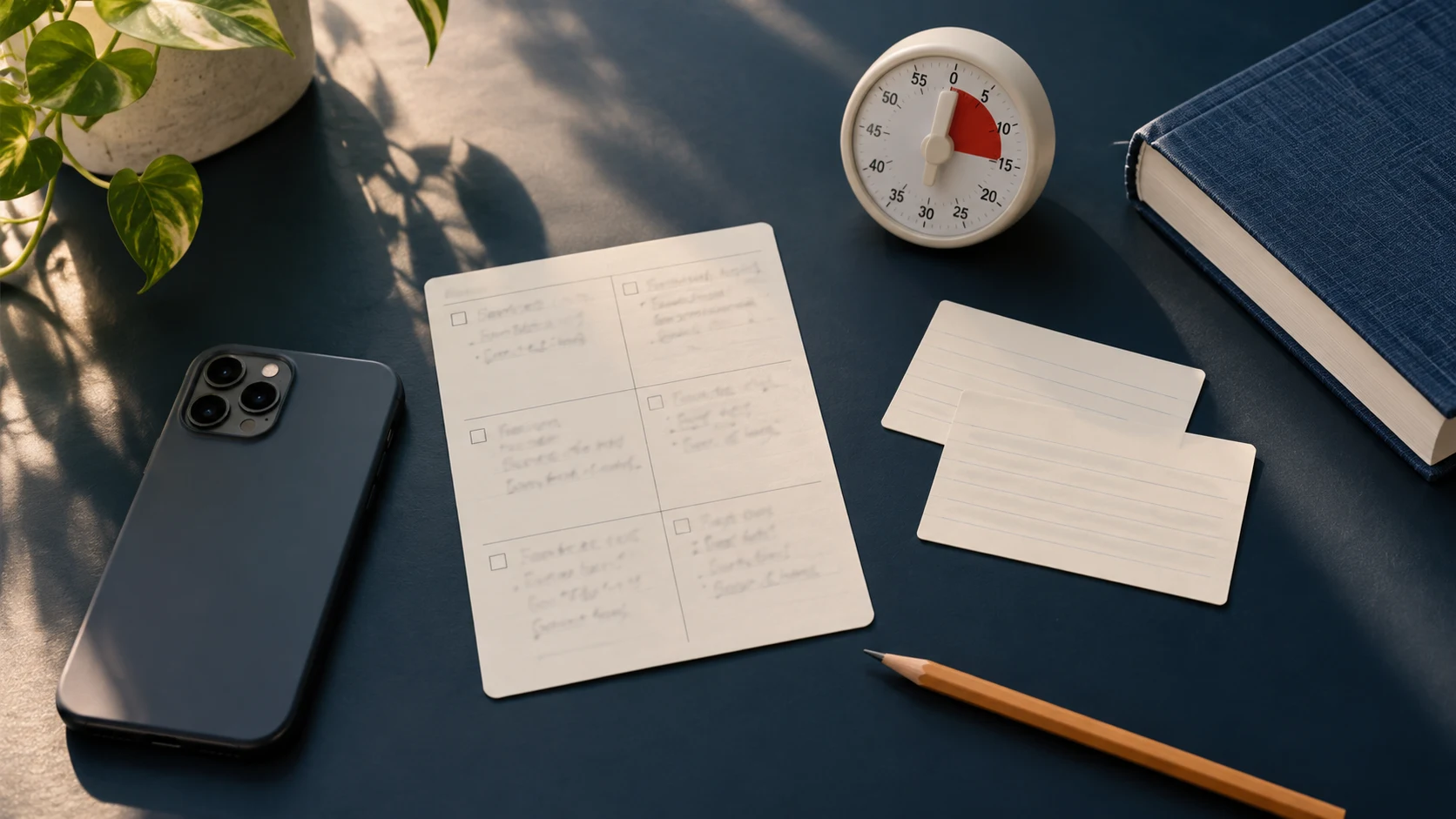

Start with one short, clearly defined task, prepare the materials and agree a phone arrangement that preserves essential support and contact. Check the work afterward, not just the minutes spent. Treat a few sessions as a practical comparison, not proof of better grades or a universal phone effect.
Start With One Piece Of Work
A phone-free study plan can become so ambitious that arranging it takes longer than the homework. Instead of beginning with a household ban, choose one task and one short period in which you can try a different arrangement. The question is practical: does this setup help you complete and check this kind of work? This is an original learning exercise, not a clinical assessment, a validated intervention or a promise of better grades. You do not need to establish that phones are universally harmful before adjusting an interruption you find inconvenient. Equally, a tidy desk and an absent phone do not demonstrate that learning has happened. Begin with the work you want to understand.
Do Not Turn Mixed Research Into A Universal Rule
Research on a phone's mere presence is not a simple instruction manual. A 2023 experimental study reported lower performance on a basic attention task when a smartphone was present. A separate preregistered replication published in 2022 did not reproduce the earlier brain-drain effect on its working-memory and attention tasks. Different findings warrant care about broad claims. Neither study establishes what will happen to your next history essay or maths revision session. Laboratory tasks, participants and conditions are not identical to a teenager's home environment. The useful response is to make a modest, observable change and inspect your own work, without describing a few sessions as proof of a general scientific claim.
Decide What Phone-Free Means For This Task
List what you actually need before moving the device. Perhaps the assignment is online, a teacher has supplied an audio file or you use an accessibility tool. Download permitted materials or arrange another appropriate way to access them where practical. If a necessary function remains on the phone, define a narrow use rather than pretending the session can be completely device-free. Preserve essential medical, accessibility and contact arrangements. England's school guidance recognises that some pupils need phone access to manage medical conditions; a home experiment should not interfere with necessary support either. This article proposes a home-study routine, not a replacement for school policy, a medical instruction or an instruction to disable assistive features.
Write A Finish Line You Can Check
Choose a task with a visible product. For example, attempt a small set of questions, mark them using an available answer source and explain one error. Or read a short passage and write a summary that you can compare with the text. These are illustrative task options, not prescriptions for a particular qualification. Avoid using time spent as the only measure. Sitting quietly for twenty minutes can conceal confusion, while asking for help can be a useful part of studying. Write what completion means before starting. If the task is too large, reduce it rather than extending the experiment indefinitely. A clear finish line makes it easier to notice what helped and what still needs teaching.
Make The First Change Small
For an initial session, choose a manageable interval such as fifteen minutes and a safe agreed place for the phone. Use a separate clock if one is available. Tell anyone who reasonably expects an immediate reply when you will check messages, and preserve a suitable route for urgent contact. Do not create uncertainty for a carer or family member merely to make the experiment look strict. Keep the first attempt simple. You do not need a new app, paid blocker, elaborate reward chart or another person monitoring your screen. The object is to reduce one source of interruption while leaving the study task recognisable. A short interval is a starting choice, not an evidence-based optimum. Choose the location in advance and agree who can retrieve the device if needed. Make the arrangement easy to reverse when essential contact or support requires it.
Record Interruptions Without Making A Confession Sheet
After the session, make three brief notes: what work you completed, what interrupted it and what remains unclear. Include interruptions unrelated to the phone, such as a missing book or not understanding the question. If you reached for the device, note what you needed or expected to find. Do not turn the record into a judgment about character. Keep private messages and other people's information out of the notes. A parent does not need access to a conversation history to discuss whether the study arrangement was workable. If you decide to share your experiment, share the task and your observations rather than screenshots containing personal information. The smallest useful record is usually enough.
Compare Similar Sessions, Not Different Lives
Try the arrangement again on a comparable piece of work. Where feasible, compare it with your ordinary setup on another similar session, without deliberately introducing distracting material. Note obvious differences such as tiredness, task difficulty or needing unfamiliar software. Change one practical feature at a time so you can explain what you actually tried. Even then, the comparison is informal. A better result could reflect easier questions, practice or a quieter evening. Do not claim the phone's location caused a grade change, calculate a misleading improvement percentage from tiny samples or generalise your experience to classmates. The exercise can still help you decide which routine is convenient enough to repeat.
Check Learning After The Timer Stops
Return to the actual work. Can you explain the method without copying it? Which answer needs correction? What question should you ask a teacher? An interruption count says little about whether a misconception has been resolved. Use the session to identify the next learning action, not just to celebrate resisting a notification. The Education Endowment Foundation's digital-technology guidance encourages decisions based on how technology will support learning. It explicitly does not focus on screen time or mobile-device use, so it should not be cited as evidence that this phone-free routine works. Its relevance here is narrower: start with the learning need and consider whether a tool serves that need.
Give Parents A Support Role
Before trying the routine together, agree what help the learner wants. A parent might help find printed material, protect a quiet interval or listen to an explanation afterward. Avoid making the arrangement a surprise confiscation or demanding constant proof that the student is concentrating. The proposed experiment is cooperative and can be revised. If the learner says the phone is needed, ask which function is required and investigate an appropriate arrangement together. If the task itself is unclear, moving the device will not provide the missing explanation. Separate a conversation about family device boundaries from a conversation about one piece of schoolwork. Both may matter, but they need not be settled in the same fifteen minutes.
Answer The Practical Questions
What if the experiment changes nothing? Check whether the task, timing or workspace was the more important obstacle. You have not failed a test. What if you finish faster but understand less? Revise the finish line to include checking and explanation. Speed is not the only useful outcome. What if you need the phone halfway through? Pause, identify the function and decide whether to use it deliberately or obtain help another way. What if a parent wants longer sessions immediately? First inspect whether the short arrangement was workable. Extend only if it serves the task and preserves necessary support. These are planning choices, not a diagnosis of attention difficulties or a treatment programme.
Keep The Part That Helps
Choose one adjustment to retain for the next similar task and one uncertainty to investigate. Your conclusion can be modest: having materials ready reduced interruptions, or a shorter task made it easier to ask a precise question. There is no need to announce a permanent transformation. Clued's StudyTok guide helps examine a learning claim before adopting it. The group-chat pressure guide considers social expectations around messages, while the schoolwork-upload guide examines a different digital decision. Start your next session with a defined task, an appropriate contact plan and a way to check the work. Keep the experiment only as complicated as the question requires.
Sources And Further Checks
Primary sources checked on 31-10-2026. Course and policy details can change; check the current official information before acting.
2023 Smartphone Presence Experiment 2022 Preregistered Replication DfE: Mobile Phones In Schools EEF: Digital Technology GuidanceAI-assisted production. How We Produce Stories · Report A Correction