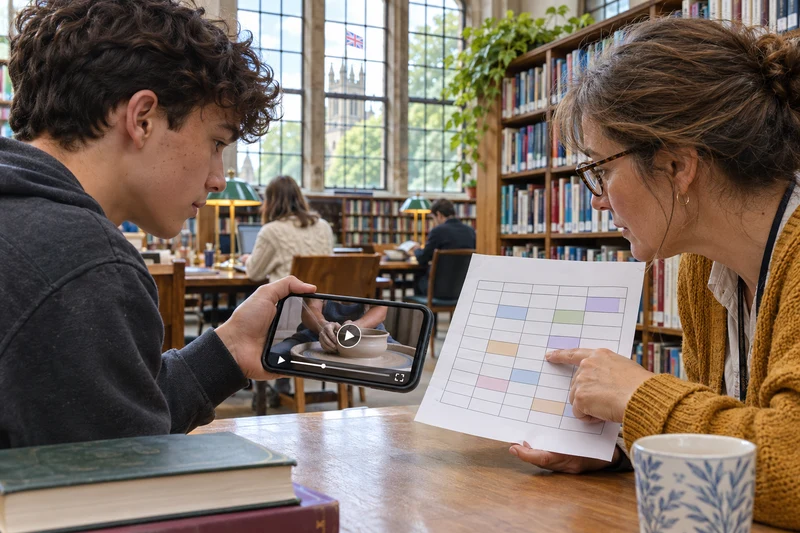
Save the moment that caught your attention, turn it into a question about first-year work and ask it of both courses. Change your shortlist when the answer changes what you expect to do there.
Catch The Moment Your List Changes
Would you still put that degree first if you had never seen the video? Imagine saving a clip of a ceramics student lifting a bowl from a wheel. A shelf of glazes fills the background. Until lunchtime your favourite course was product design; now you are looking up ceramics degrees on the bus home. There is something useful in that little jolt of envy. The tricky part is working out what you envy.
Watch it once more with the sound off. Perhaps it is the sight of a hand steadying a wobbling rim that holds your attention. Perhaps it is the idea of spending a whole afternoon in a workshop, away from a laptop. Or perhaps it is the confidence of someone who seems to have found their people. Those are three different wishes. Only the first points particularly strongly towards clay. Write down the bit you would like to borrow before you borrow the student's course choice.
Separate The Scene From The Claim
Fold a sheet of paper in half. On the left, describe what somebody standing beside the camera could have seen. On the right, write what you have started to believe about the degree. The left might say a student threw a bowl in a light studio. The right might say first years can spend most afternoons making their own pieces. Notice how much work the words first years, most and own are doing. None of them follows from the picture.
Keep the clip as a bookmark and turn just one of those words into a question. For first years, look for the course stage at which students use the wheel. For most, look for how studio time fits alongside lectures and independent work. For own, ask who sets the brief. The answer needn't spoil the attraction. Finding out that you would start with an unfamiliar material might be precisely the reason to put the course on your list.
Apply the same courtesy to a gloomy post. A late night before a hand-in is evidence that one person had a late night. It does not give you the timetable for a term. If the post unsettles you, the question worth carrying away might be how deadlines cluster, or where a student can get feedback before a submission.
Compare Two Ordinary Tuesdays
Pick one course from your original shortlist and one from the video. For each, find the university's page for the same entry year and the relevant campus. Start with compulsory work in the first year. Find a task you can picture doing on an ordinary Tuesday: testing how a handle feels, reading about a material, sketching alternative forms, or explaining why an early attempt cracked. Use the provider's description; leave the space empty if it doesn't say.
Now imagine being halfway through that task. Which part would you like somebody to teach you? Which would you persevere with even if the result looked unimpressive? It is easier to picture taking the bowl home than cleaning the wheel and trying another rim. Product design deserves a fair hearing too. A photograph of a finished prototype tells you as little about how much you would enjoy revising it as the bowl tells you about clay.
Clued’s guide to reading a university module catalogue is useful if a long list of attractive options is drowning out the compulsory work. UCAS research on course descriptions found that even when prospective students could find module titles, the detail beneath them could be thin. Treat a gap as a question for the department. Avoid filling it with whichever post you remember most vividly.
Give The Quiet Course An Equal Audition
There is an easy way to rig this comparison without meaning to. You watch four clips from one course and read a grey block of text from the other. By the time you close the tabs you can practically smell the wet clay, while the second course is still just a name. Give both courses the same small request: an example of a first-year brief and an indication of what the student hands in.
If you visit, take the request with you. Rather than waiting for a tour to pass the most photogenic room, ask how a beginner gets from the first demonstration to a finished submission. If the answer mentions open access, follow up on what that means for someone learning the equipment. If you can't visit, the same question works in an online session. The open-day decision story may help if a lively tour has left one course feeling far more familiar than the other.
You can also learn something by reversing the experiment. Picture a clip of the less visible course made with the same music, warm lighting and proud reveal. Would your preference wobble? If it would, record that as a reason to get better information about both courses. You haven't failed a test of judgement. You have found a difference that could disappear when the camera changes hands.
Read The Label Beside The Number
When the posts disagree, it is tempting to settle the argument with a percentage. For UK higher education, Discover Uni explains how to compare course data. Its figures can bring in more voices than one student's video. Read who those voices belong to. Sometimes the results cover related courses at an institution or combine two cohorts because a single group was too small to report separately.
Suppose your question is whether beginners get useful feedback on practical work. A broad subject figure can give you context, but it cannot tell you what a ceramics tutor will say about your first bowl. Look at the wording of the survey question, the number who answered and the courses represented. Write the scope beside the figure. You can then ask the course team for an example of feedback on an early assignment without asking a survey to answer a question it never posed.
Give the video and the survey different jobs. Let the clip identify something specific that matters to you; let the survey suggest whether a wider group was asked about a related experience. Where neither tells you how often the studio opens, leave that question with the people who run it.
Before sharing a screenshot with a parent, include the label and response count in the crop. A bare percentage is unusually easy to remember and surprisingly hard to put back in context a week later. Save the course link beside it so you can retrace your reasoning.
Change One Line Before You Change Your List
Before moving either degree, complete a sentence: I would move this course up if I learned that… Choose a condition that somebody could actually check. Regular access to supervised making in the first year is more useful than a creative atmosphere. Pair it with one condition that might move the course down. If both answers would leave your ranking untouched, you may already be choosing on a different basis. Try naming that basis honestly.
For families, this is a better conversation starter than asking why yesterday's favourite has suddenly been abandoned. Ask the student to show you the ten seconds they keep returning to. Listen for the verb: making, explaining, performing, collaborating. Then look together for that activity in two different degrees. Clued’s comparison of law and psychology through a week of work uses this approach for two subjects whose daily demands are harder to photograph.
Finally, give yourself permission to keep the clip even if the course comes off the list. It may have taught you something more portable than a university name: that you want to work with your hands, show unfinished work to other people or get feedback while you can still change a design. Take that preference into your next course search. It came from watching somebody else, but the decision it helps you make is yours.