
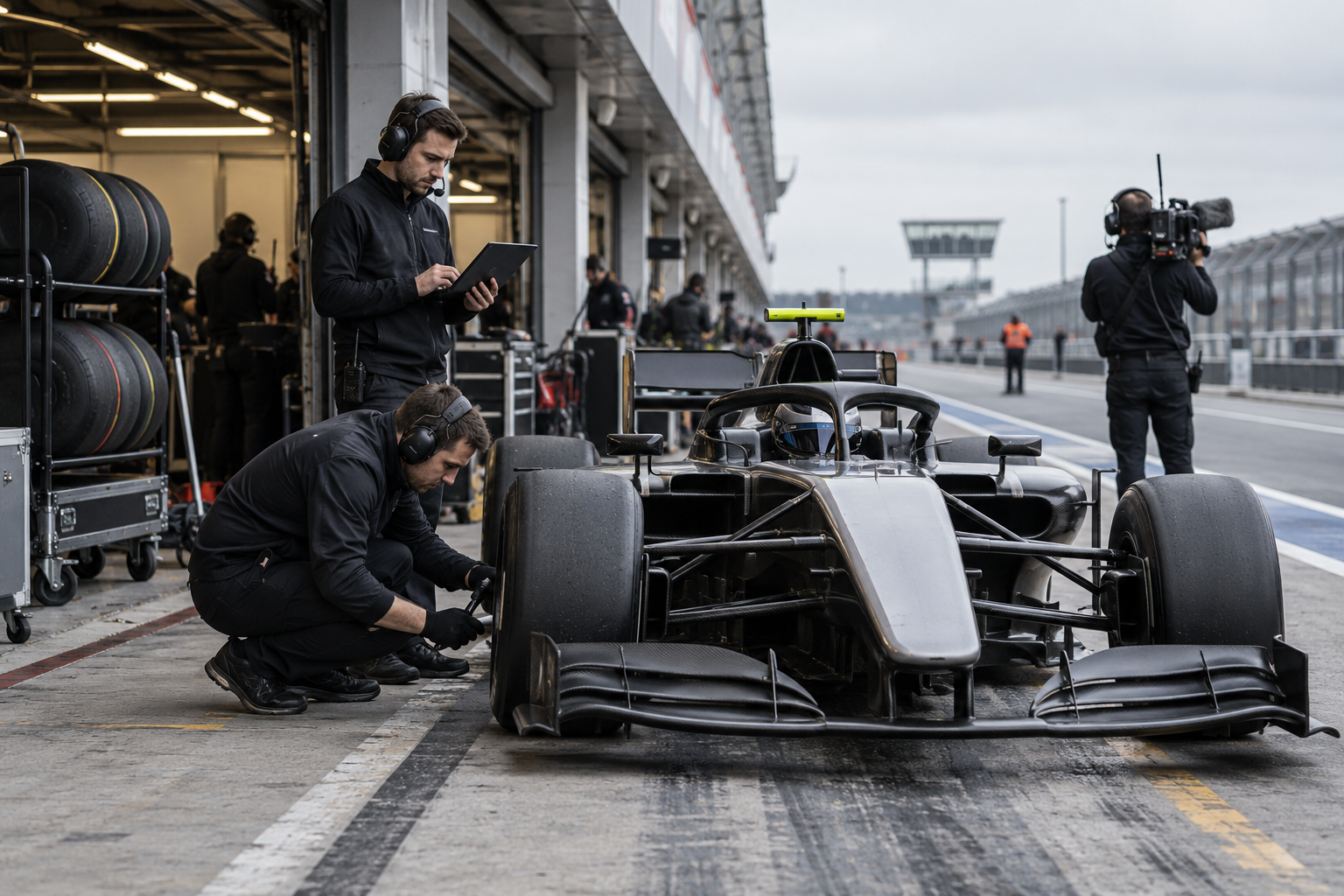
Careers behind a Formula One race weekend include engineering, software, logistics, broadcasting, event management, commercial work and corporate support. Start by comparing actual tasks and employers, then check the individual course or vacancy requirements; enthusiasm for racing alone does not establish career fit.
Look Beyond The Driver
A race broadcast makes a complicated workplace look like a contest between the people in the cars. That is part of its appeal. For a student exploring careers, however, the more useful question may be what had to happen before those cars reached the grid, and what has to keep working while the race unfolds. There are physical objects to prepare, information to interpret, pictures to transmit and people to coordinate. Each points towards a different kind of work. Formula 1’s official careers pages describe roles across engineering, broadcasting, logistics, legal work, event management and commercial activity. This feature uses those employer descriptions and dated operational examples, checked on 7 October 2026. It is an evergreen career exploration, not a report of new recruitment. The exercises below are Clued’s suggestions for learning about tasks; they are not employer selection tests or predictions of admission or employment.
Separate The Employers Before Comparing The Jobs
The organisation running Formula 1 and a racing team are different employers. A job supporting the championship’s television output is different from a job supporting one team’s car. Formula 1’s department pages distinguish technical, operations, broadcast and media, commercial, corporate and race functions. McLaren Racing’s early-careers page provides a separate view of routes within a racing organisation. Start a research note with the employer’s name, the department and the specific role. Then add where the work happens and which racing series it supports. A familiar motorsport brand can cover several activities, so do not assume every advertised role involves Formula One or travelling to races. Read the actual description. This simple distinction stops an attractive company name from doing all the decision-making and gives you something concrete to compare with jobs elsewhere.
Engineering Begins With A Problem You Can Define
Engineering is an obvious starting point, but it is too broad to function as a complete career choice. Designing something, producing it, testing it and investigating why it failed involve different tasks. McLaren’s early-careers material includes hands-on engineering development as well as graduate pathways. That makes it worth investigating both the intellectual problem and the practical process behind a job title. For a safe introductory exercise, design a cardboard structure that must hold a small, agreed load. State the constraint before you begin. Sketch two versions, build one and record what you changed after testing. Use ordinary craft materials and avoid anything hazardous. Notice whether you enjoyed the drawing, making, measuring or explanation most. You have not recreated racing engineering. You have produced a small piece of evidence about which part of solving a physical problem makes you want to continue.
Precision Has Its Own Appeal
Some students enjoy the idea of inventing a design; others prefer getting a thing made accurately and consistently. Do not treat those interests as a hierarchy. An engineering exploration becomes more useful when it includes the work of translating instructions into something that can be checked. McLaren describes apprenticeship and trainee routes alongside its other early-careers programmes, including specialist hands-on development. Try writing a set of assembly instructions for a simple paper model, then ask someone to follow them without extra explanation. Where did they interpret the instructions differently? Which dimensions or steps were missing? Revise the instructions and try again. The exercise makes accuracy visible without expensive equipment. If you like the checking and revision more than the original design, explore technical and manufacturing roles as well as courses with prominent design content. Actual requirements must come from current role and course pages.
Software And Data Still Need Clear Questions
Formula 1 identifies software development and timekeeping among its activities. That is a useful reminder that technology careers can concern the information surrounding an event as well as the machines taking part. A student’s first question should be what the software helps someone do, which information it depends on and how an error would be spotted. Create an explicitly fictional set of lap times or timed walking laps. Put them into a spreadsheet and calculate a simple average. Then introduce a missing value or an unusually large number. Explain how it changes the result and what you would check before relying on the comparison. Do not present this as race-strategy modelling. Its purpose is to practise making assumptions visible. If the investigation is interesting, compare computing and data-related learning tasks rather than choosing a course purely because its title sounds connected to racing.
Logistics Turns A Deadline Into A Sequence
A race weekend needs equipment in the right place at the right time. Formula 1’s October 2023 logistics explainer describes DHL’s work moving the sport between venues and racing teams’ own logistics staff moving parts. It remains a useful historical illustration of the work behind the spectacle; it does not establish today’s transport arrangements for every event. You can test the underlying interest with a much smaller project. Plan the equipment for a school display, club session or family gathering. List the items, who supplies them, when they are needed and what happens if one arrives late. Separate essentials from things that can be substituted. Ask someone else to find a dependency you missed. If organising the sequence absorbs you more than designing the display, investigate logistics and operations. The attraction may lie in making a plan resilient, rather than in the subject of the event itself.
Broadcasting Includes The People You Never See
The presenter is only one part of the viewing experience. Formula 1’s feature published on 14 February 2025 describes production coordination, camera and audio crews, graphics and collaboration between people at the circuit and its Media & Technology Centre in Biggin Hill. It shows why producing a live programme involves both technical systems and editorial judgement. Make a one-minute explanation of a harmless activity you understand, such as a board game or a craft process. Plan what the viewer needs to see before recording. Use your own footage and obtain permission from anyone appearing. Edit for clarity, then ask a viewer which step was confusing. Were you most interested in presenting, selecting pictures, improving sound or arranging the sequence? Those reactions are more useful than simply deciding you would like a media job. Keep the exercise private unless you have checked permissions and the rights to everything included.
Good Communication Starts With The Audience
A committed fan and a first-time viewer bring different knowledge to the same event. Formula 1’s 2025 broadcasting feature describes the challenge of explaining the sport to audiences with different levels of familiarity. That problem extends well beyond motorsport: a clear explanation needs to anticipate what its reader or viewer does not yet understand. Write two short accounts of the same process, one for someone who already knows it and one for a beginner. Underline any specialist terms and decide whether each needs explanation. Ask the beginner to describe the process back to you. A misunderstanding is a chance to revise the writing, not evidence that the reader was inattentive. If you enjoy that revision, explore communications, journalism and content work alongside technical subjects. You can be interested in a technical world while finding your strongest curiosity in explaining it.
Commercial Work Asks A Different Set Of Questions
Formula 1’s commercial department description includes sponsorship, marketing, media rights and hospitality. These activities suggest another way into exploring the sport: ask how an organisation understands its audience, presents an offer and supports a business relationship. Watching a race enthusiastically does not automatically mean you would enjoy those tasks. Choose a fictional community event and write a one-page sponsorship proposal. State whom the event serves, what support it needs and what you could responsibly offer in return. Leave out invented audience numbers and promises of sales. Ask a reader which statements require evidence. Then revise the proposal so the assumptions are explicit. This exercise can help distinguish interest in persuasion, audience research and planning. It is not a real sponsorship pitch and should not be sent to businesses as if an event or partnership exists.
Support Functions Belong In The Career Picture
Formula 1 lists legal, security and event management work, and its corporate department description includes communications, human resources and legal support. A career map that stops at the car misses these functions. For a young person, the practical value is recognising that a favourite industry can contain roles built around very different skills. Take one ordinary event you know and map the questions that sit around it: who is responsible for the venue, who may attend, what permissions are needed and how a participant asks for help. Do not attempt specialist legal or security work. Simply identify where a trained person or an official rule would be needed. Then choose one function to research through a current job description. Ask which duties appeal outside motorsport too. That keeps the exploration useful even if your eventual employer operates in another sector.
Read The Entry Route In Full
McLaren Racing’s early-careers page, checked on 7 October 2026, describes graduate programmes, internships, apprenticeships and trainee programmes. Its apprenticeship overview specifies Levels 3–6, durations of three to five years and September starts. These details belong to that employer’s description; they are not a universal timetable or an assurance that a suitable place is available. For any route, read the individual advert before drawing conclusions. Record the qualification requirements, location, application deadline and any stated work-permission conditions. If something is unclear, use the employer’s official contact or application guidance. Separate a general programme overview from a live vacancy. This article does not assess anyone’s eligibility. Build an alternative around the same tasks in another organisation or industry, so that learning and applications can continue even when one particular opening is unavailable.
Three Questions Before You Apply
Would you enjoy the task outside motorsport? Compare one role in racing with a role in another industry that uses similar work. A logistics plan, software check or clear explanation can be interesting in several settings. Write down which duties attract you in both descriptions, and which attraction depends mainly on the racing brand. This is a reflection exercise, not a test of commitment. What evidence do you have that you want to practise it? Choose one artefact from your exploration and explain your decisions, mistakes and revisions. You do not need an impressive finished product. A modest example you understand can give you a more useful discussion than an ambitious project you cannot explain. Record the part you would try again and the help you would need. What must you check before acting? Return to the individual employer or course page for requirements, location and deadlines. Keep unanswered questions visible. Then choose a next step you can complete this week: another small exercise, a conversation with an adviser, or a closer comparison of two current descriptions.
Leave With Evidence You Can Discuss
Choose two of the exercises above rather than trying everything. Before starting, write what you expect to enjoy. Afterwards, record what you actually wanted to spend more time on, what needed help and what you would change. Keep the artefact: a sketch, spreadsheet, short video or revised plan. It gives a teacher, careers adviser or parent something specific to discuss without turning a hobby into a career verdict. For more on that approach, read The Project That Revealed More Than A Career Test. If an existing talent is complicating your decision, try When Your Biggest Talent Does Not Give You A Clear Career. You can continue loving the race while investigating which work, if any, you would like to practise. The next useful question is which task deserves a second attempt.
Sources And Further Checks
Primary sources checked on 07-10-2026. Course and policy details can change; check the current official information before acting.
Formula 1: Careers Formula 1: Meet The Teams McLaren Racing: Early Careers Formula 1: Behind F1 TV (14 February 2025) Formula 1: Logistics Explainer (20 October 2023)AI-assisted production. How We Produce Stories · Report A Correction