
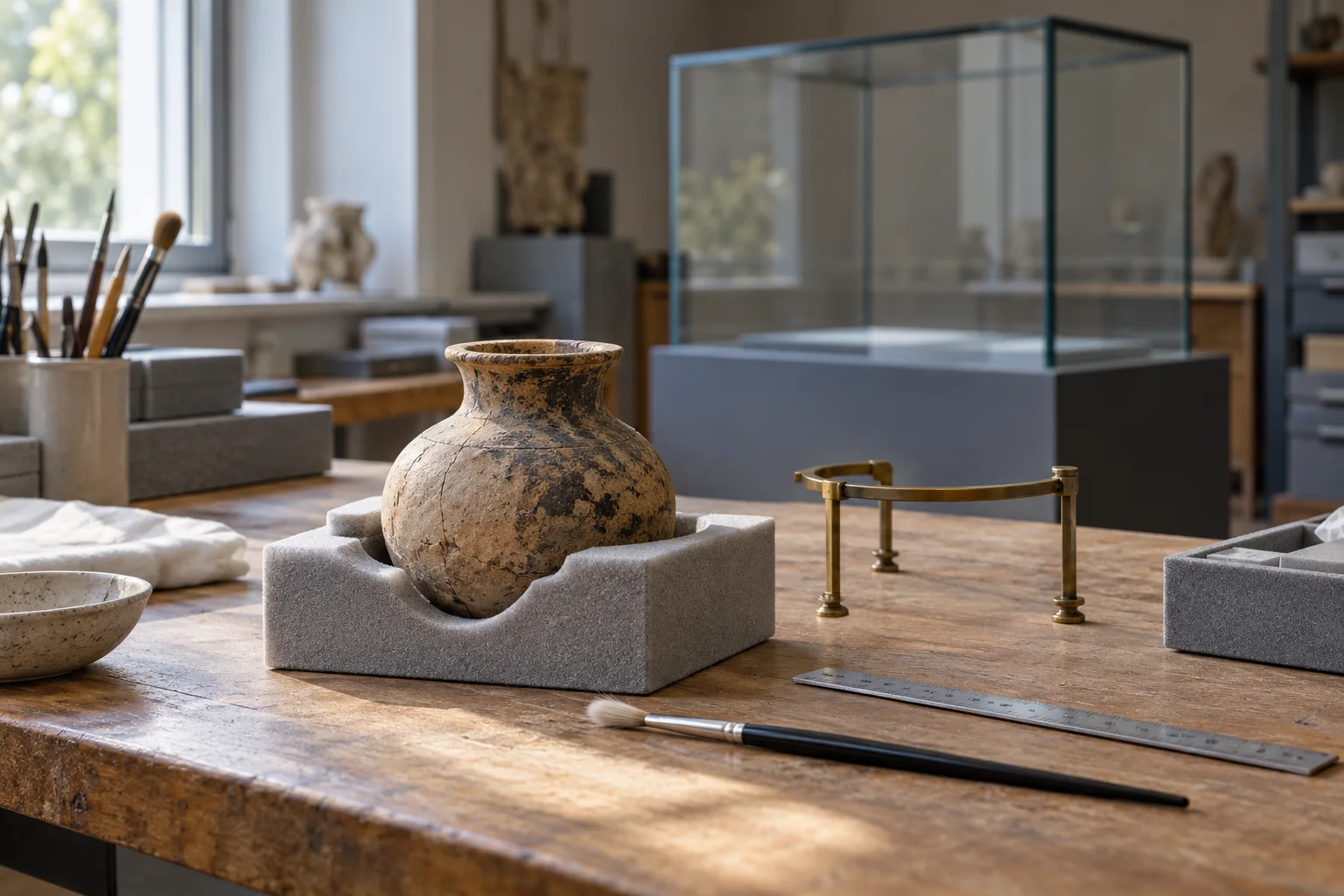
A museum object reaches a display case through a chain of decisions: lawful acquisition or loan, documentation, condition assessment, research, conservation, exhibition selection, case and mount design, interpretation, accessibility checks, installation and continuing monitoring. Curators are only part of the team; registrars, conservators, technicians, designers, scientists, writers and access specialists also shape what visitors see.
The Display Case Is The End Of A Long Journey
A museum label may give you a name, date, material and a few lines of history. It rarely shows the months or years of work that put the object safely in front of you. Before the doors open, someone has asked whether the museum should hold or borrow it, whether its ownership history is acceptable, what condition it is in, what it can teach, how much light it can tolerate and how a visitor will understand it. That chain is useful for anyone exploring careers. Museums employ people who combine history with law, chemistry, logistics, engineering, writing, photography, digital systems and visitor research. The object in the case is the visible result of their shared decisions. No single institution follows an identical route, and a borrowed object takes a different legal path from a purchase or donation. The stages below are therefore a realistic map, not a universal conveyor belt.
First, The Museum Must Have A Reason To Take It
An object may arrive as a proposed gift, purchase, bequest, archaeological find or loan. Arrival does not automatically mean acceptance. The museum considers whether the object fits its collecting policy, whether it can care for it and whether taking it would be lawful and ethical. The British Museum’s acquisitions policy, for example, says provenance and relevant national and international rules must be considered. Provenance means the object’s ownership and movement history; gaps can matter because cultural property may have been stolen, looted or exported illegally. Collections Trust describes accessioning as a formal commitment by a governing body to care for an object over the long term. That wording reveals the size of the decision. Accepting an object is not merely finding shelf space today. It creates responsibilities for documentation, storage, security and future access. Registrars, collections managers, curators and legal or governance colleagues may all contribute. They may decline an appealing object when title is unclear, the collection already contains stronger examples or the museum cannot care for it responsibly.
Then It Needs An Identity And A Location
Once an object enters the museum, staff record why it is there, who brought it, what was received and under what terms. If it becomes part of the permanent collection, it receives a unique accession number linked to its record. Cataloguing can add names, makers, dates, materials, dimensions, history, rights information, associations and references. Some facts will remain uncertain; good documentation distinguishes evidence from interpretation. Location control sounds ordinary until you imagine thousands or millions of items spread across stores, studios, galleries and loans. Collections Trust’s standard requires museums to keep a record of where objects can be found and update it when they move. A move from shelf to photography studio is therefore not casual. Someone authorises it, records the new location and keeps the number with the object. Database specialists and documentation officers make this information usable. Their work lets a colleague retrieve the correct object and reconstruct what happened to it years later.
Condition Comes Before Cosmetic Improvement
A conservator or trained colleague examines the object and records its condition. They may photograph cracks, corrosion, fading, loose parts, old repairs or insect activity. Collections Trust advises condition checks after significant changes in an object’s use or environment. For a loan, reports may be compared at packing, arrival, installation and return so changes can be identified. Conservation is not simply making something look new. The British Museum defines authenticity in conservation as an ethical requirement not to change an artefact’s aesthetic or integral meaning through treatment. Sometimes active treatment is necessary; sometimes the safest choice is support, a controlled environment and minimal intervention. Scientific researchers can identify materials or manufacturing techniques and help conservators choose evidence-led care. Preventive conservators focus on reducing future harm from light, humidity, pests, pollutants, vibration, handling, fire or water. This is where chemistry, materials science, photography and patient manual skill meet historical judgement.
Research Changes What The Object Can Say
A catalogue record is a starting point, not the final story. Curators and researchers compare the object with other collections, archives, excavation records, technical images and published scholarship. They may consult source communities, artists, makers or subject experts. New evidence can change a date, identify a material, correct an attribution or challenge language inherited from an earlier catalogue. Provenance research also continues after acquisition. A lawful title does not answer every question about how an object moved through colonial, wartime or commercial systems. Research may expose uncertainty rather than eliminate it. That uncertainty belongs in the interpretation when it affects the story. Behind a short label may be a database trail, correspondence, translations, laboratory results and disagreement among specialists. Research careers in museums therefore involve source criticism and collaborative judgement as much as knowing facts.
Selection Is A Storytelling Decision
Most museum collections are larger than their display space. An exhibition team selects objects that can answer its central questions, survive the planned conditions and work together for visitors. A famous object is not automatically the best choice. A modest tool, fragment or everyday item may reveal an experience that a ceremonial masterpiece cannot. The team also asks what is missing. Whose account dominates? Does grouping objects by place, date or material hide a more useful relationship? Could a replica or digital image provide access when an original is too fragile? Curators propose connections, but educators, community partners, designers and audience researchers may test whether those connections make sense beyond the specialist team. Budgets and schedules impose real limits. Borrowing can add a crucial object, yet it also introduces agreements, insurance or indemnity, transport, courier and facility requirements. Exhibition planning is the practice of making these trade-offs visible and defensible.
The Case Is A Small Engineered Environment
A display case is not just a transparent box. Designers and technicians consider security, access for installation, lighting, airflow, materials and the weight and shape of everything inside. Mount makers build supports that hold an object securely without creating damaging pressure. Structural engineers may advise on large or heavy pieces. Electricians and lighting designers make the display legible while respecting conservation limits. The correct environment depends on the object’s materials and condition. The V&A says providing a suitable climate for display, storage and transport is an everyday concern, monitored through temperature, relative humidity and light data. Light damage is cumulative for vulnerable materials, so a textile, watercolour or manuscript may need low illumination or limited display time. A sealed case can create a smaller controlled environment within a gallery. Sensors may continue collecting data after opening. The apparent stillness of the display is maintained through measurement and adjustment.
Words, Sound And Touch Build The Visitor Route
Interpretation turns specialist research into a route visitors can enter. Writers decide what the label must explain, what belongs in a longer panel and what can be explored through audio, video or a digital guide. Editors check clarity and accuracy. Graphic designers manage type size, contrast and hierarchy. Translators and rights specialists may also be involved. Access cannot be an afterthought added when the cases are fixed. Smithsonian guidance treats accessible exhibition design as a whole that includes content, label design and text. Depending on the exhibition, that may mean step-free circulation, seating, readable labels, captions and transcripts, audio description, sign-language content, tactile maps or replicas, and controls that can be reached and understood. Not every object can be touched, but a handling object or three-dimensional reproduction can communicate form while protecting the original. Access specialists help the team identify barriers; disabled visitors and community reviewers can reveal problems that a checklist misses.
Installation Is Choreographed, Not Improvised
Before installation, teams agree a sequence. A large case component may need to enter before a small object; a mount must be tested before the original is placed on it; painting and construction dust must be finished before sensitive material arrives. Registrars coordinate movements and paperwork. Art handlers and technicians use planned routes, equipment and enough people for the load. Conservators may supervise unpacking and examine the object against its condition report. The final placement can look almost effortless because difficult decisions happened earlier. The team checks stability, distances, labels, lighting, alarms and sightlines. Photographing the finished installation creates a reference. After opening, gallery staff notice visitor behaviour, facilities staff monitor the building and collections teams review environmental readings or signs of change. If a mount shifts, a light level is wrong or an object deteriorates, the display can be altered or closed. Opening day begins another phase of care rather than ending the project.
Try The Object Journey Exercise
Choose one object visible in a museum’s online collection. On a page, draw five boxes: **Ownership**, **Evidence**, **Care**, **Display** and **Visitor**. Under each, write one fact you can verify and one question the public record does not answer. For example: Who owned it before the museum? Which material is most vulnerable? Why was it selected? Can a visitor access the story without reading small print? Now add one role beside every unanswered question. You might assign a provenance query to a researcher, a crack to a conservator, a missing location to a documentation officer and an unreadable label to an access editor or graphic designer. Spend no more than 30 minutes. This is not an assessment of whether you are suited to museum work. It is a way to notice which kind of problem holds your attention: evidence, materials, systems, storytelling or people.
Reader Questions, Answered
**Why are only some objects on display?** Space is one reason, but not the only one. An object may be fragile, under research, on loan, awaiting conservation or simply not relevant to the current story. Stores are active research and care spaces, not necessarily forgotten rooms. **Do museum staff always wear gloves?** No single rule fits every material and task. The responsible approach is to follow the institution’s handling procedure and the conservator’s assessment. Gloves can protect some surfaces, but reduced grip can create another risk. **Does conservation erase damage?** Usually the purpose is preservation, understanding and safe access, not returning an object to an imagined original state. Treatment choices should be documented, proportionate and ethically justified. **Is curator the main career?** It is one visible route among many. If you enjoy databases, logistics, chemistry, making, editing, photography, access or building systems, the same display may contain a career clue for you.
Your Next Step
Visit one gallery and study a single case for ten minutes. Look beyond the object: notice the mount, light, label height, viewing distance, security and alternative formats. Write down three jobs that probably influenced what you see, then check the museum’s staff pages, vacancies or professional profiles to test your guesses. If hidden teamwork appeals to you, read The Careers Behind A Formula One Race Weekend. To turn curiosity into evidence about yourself, try A Project Can Tell You More Than A Career Test. And if you are comparing broad interests with course choices, Talent Without A Career Label offers a way to keep several routes open. Your practical next step is small: map one object, identify one role and find one real entry route into that work.
Sources And Further Checks
Primary sources checked on 10-10-2026. Course and policy details can change; check the current official information before acting.
Collections Trust: Acquisition And Accessioning Collections Trust: Location And Movement Control Collections Trust: Condition Checking And Technical Assessment British Museum: Acquisitions Policy 2024 British Museum: Collection Care V&A: Climate Resilience For Museum Collections Smithsonian: Guidelines For Accessible Exhibition DesignAI-assisted production. How We Produce Stories · Report A Correction